
The inflation target of the RBI would be reviewed once every five years.

Global oil prices fell on Thursday to their lowest levels since before the outbreak of the Iran conflict, offering a significant economic tailwind for India, the world's third-largest crude importer, by easing inflation risks, reducing the import bill and improving the government's fiscal position.

'If the war continue for a longer period of time, it is just a matter of time before the government will pass on some of the price increases.'

'...A new challenge has emerged in the form of Mythos.'

Highlights of the RBI monetary policy.


Reserve Bank of India Governor D Subbarao on Friday increased mandatory cash reserve of banks held by RI by 75 basis points (0.75 per cent) in a bid to suck excess liquidity to combat rising inflation.

Nomura has increased its March 2027 target for the Nifty 50 to 25,900, driven by strong corporate earnings and attractive market valuations, even as risks from the West Asia conflict and high oil prices persist.

The RBI Governor, however, added it was 'difficult to say when that will take place and in what shape it will roll out'.

The RBI on Thursday hiked key policy rates for the 10th time since March, 2010, in a bid to tame inflation, which crossed the 9 per cent mark in May.

he government in its budget for 2009-10 proposed to raise Rs 4.5 lakh crore (Rs 4.5 trillion) from the market, up from Rs 3.1 lakh crore (Rs 3.1 trillion) in the previous year and pegged the fiscal deficit at 6.8 per cent of the GDP as against 6.2 per cent in 2008-09.

The central bank was widely expected to maintain status quo.

Faced with the challenging task of balancing growth and inflation, the Reserve Bank of India will take measures in its quarterly review later this month to perk up the economy and to control inflation, which rose to 0.83 per cent for the third week of September.
RBI's previous monetary policy was announced on September 29.

The RBI has set up a panel to review ATM charges, and fees levied by banks.

The International Monetary Fund (IMF) has said the tightening of monetary policy by India is an 'appropriate' step, as the country is faced with high inflation and needs to consolidate the fiscal measures initiated during the slowdown.

Asked if the RBI will cut rates in its upcoming policy review, he said the central bank will definitely factor into account various developments and make an assessment of the macro economic conditions.

Crude oil prices surged over 3% in futures trade after US President Donald Trump expressed doubts about the Iran ceasefire, reigniting fears of supply disruptions from West Asia and pushing Brent crude above USD 107 per barrel.
The Indian government has extended the Reserve Bank of India's (RBI) mandate to maintain retail inflation at 4 per cent, with a tolerance band of 2 per cent on either side, for another five years until March 2031.

This is the fourth consecutive time that the RBI has kept key interest rates unchanged despite clamours from the industry to cut rates to boost economy.
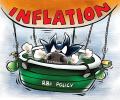
The policy will be presented in the backdrop of rising inflation.

The consumer price index (CPI)-based inflation hitting an all-time low in October would encourage the six-member monetary policy committee (MPC) of the Reserve Bank of India (RBI) to cut the policy repo rate in its upcoming December 3-5 meeting. However, the July-September GDP growth, expected to be above 7 per cent, may act as a deterrent.

A foreign brokerage warns that sustained crude oil prices above USD 100 per barrel could push India's inflation above the RBI's tolerance level, potentially triggering interest rate hikes.

The Indian banking system's net liquidity surplus has reached a four-year high of Rs 4.57 trillion, driven by maturing government securities, with further maturities expected to push the surplus to around 5 trillion.

Of the seven members, four are proposed to be government nominees and the rest from RBI.

The Reserve Bank of India (RBI) has projected that crude oil prices will average USD 85 per barrel and the rupee will weaken to 94 against the dollar by FY27, according to its bi-annual Monetary Policy report.

Insights from behavioural economics suggest that an ambitious nudge can be effective if three conditions are met, points out Ram Singh Insights from behavioural economics suggest that an ambitious nudge can be effective if three conditions are met, points out Ram Singh, director, Delhi School of Economics.
India Ratings and Research predicts the Reserve Bank of India (RBI) will maintain the repo rate at 5.25 per cent throughout FY27, despite potential inflationary pressures from higher fuel prices, with inflation expected to remain within the central bank's tolerance band.

India's retail inflation, measured by the Consumer Price Index (CPI), increased to 3.48 per cent in April, up from 3.40 per cent in March, primarily due to a surge in prices of gold and silver jewellery, as well as certain kitchen staples like tomatoes and cauliflower.

Indian markets on Dalal Street rallied sharply as easing tensions in the US-Iran conflict and stable oil prices boosted sentiment. Track Nifty 50 and BSE Sensex performance and key global triggers.

Even if there is an early agreement on a cessation of hostilities in West Asia, the price shock will not go away easily, points out A K Bhattacharya.

Weighed down by a weak rupee, the Reserve Bank on Tuesday chose to keep all key interest rates unchanged and asked the government to take urgent steps to reign in the high current account deficit.
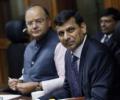
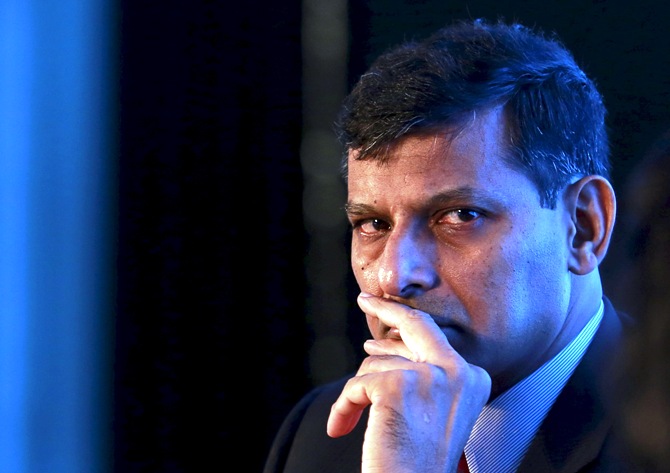
RBI Governor Raghuram Rajan has been pursuing hawkish monetary policy stance to keep inflation under check.
The RBI's bi-monthly policy review on June 3 will be the first after Prime Minister Narendra Modi assumed office on May 26.
The Monetary Policy Committee (MPC) is expected to maintain the status quo on policy rates for the fourth consecutive time in its October 4-6 review meeting. The incremental information available since its last meeting in August suggests that growth and inflation prints for the second quarter (Q2) of financial year 2023-24 (FY24) will exceed the committee's projections. However, the Consumer Price Index (CPI)-based inflation is expected to moderate in the second half (H2) of FY24.

The bank chiefs have also cancelled the customary media conference after the bi-annual policies.

"It is heartening to note that the RBI has chosen growth over monetary tightening and inflationary fears," FICCI president Harsh Pati Singhania said.
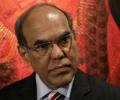
Remarks come at a time when he is under pressure from the govt to cut interest rates.

After a 25 basis point rate cut in December, the RBI on Friday decided to pause on the policy rate front amid geopolitical uncertainties.
